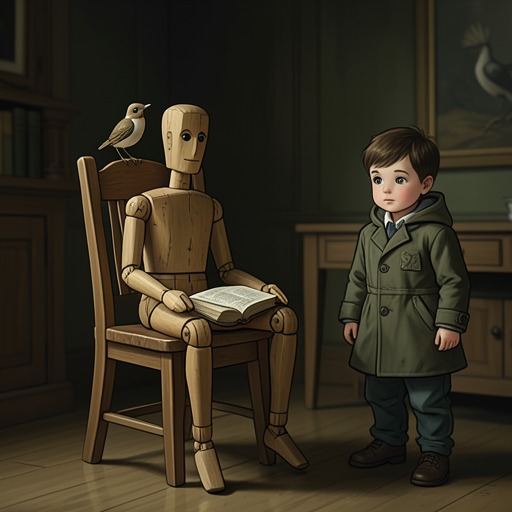
Pinocchio Trusts the Fox and the Cat Again, and They Steal His Coins
Pinocchio (Tania Zamorsky Edition)Pinocchio Trusts the Fox and the Cat Again, and They Steal His Coins shows how a familiar promise of effortless riches draws Pinocchio back into the same company that had deceived him before. The Fox and the Cat lead him to the Field of Miracles with four gold coins still in his possession, persuade him to bury them, and then take them while he is away. The episode’s decisive reversal is physical and unmistakable: after imagining a harvest of thousands, Pinocchio digs into the earth and finds nothing.
The Reunion and the Renewed Temptation
Pinocchio’s return to the Fox and the Cat begins when he sets off through the woods to meet Geppetto. The Blue-Haired Fairy has allowed him to go, directing him along the forest road and suggesting that he will find his father there. Running eagerly, Pinocchio stops near the great oak when he thinks he hears people among the branches. The figures who appear are the Fox and the Cat, his former travelling companions, with whom he had dined at an inn. Their unexpected reappearance interrupts his search for Geppetto and brings an earlier relationship back into the present.
The pair greet him familiarly and ask why he is there. Their easy recognition and apparent warmth help make the renewed approach feel like a reunion rather than a warning. When they ask about his gold, Pinocchio explains that he still has four coins: he spent one at the inn on their previous journey. The Fox turns that remaining money into an opportunity, urging him to plant it in the Field of Miracles. There, she promises, four coins might become a thousand or two thousand by the following day. The offer rests on an attractive reversal of ordinary effort: instead of earning money through work, Pinocchio is told that he can bury what he has and soon reap a fortune.
The Fox reinforces the urgency by claiming that a great lord has bought the field and that from the next day nobody will be allowed to plant money there. When Pinocchio asks how far away it is, she says it is only two kilometres away and estimates that they can reach it in half an hour. He could plant the coins at once, she says, collect two thousand a few minutes later, and return that evening with full pockets. The short distance and supposedly closing opportunity make the extravagant promise seem immediate rather than remote.
The Choice and the Planting
Pinocchio hesitates before agreeing. The pause brings to mind the Blue-Haired Fairy, Geppetto, and the warnings of the Talking Cricket: three sources of care or counsel that could have interrupted the scheme. But he eventually shakes his head and agrees to go with the Fox and the Cat. The narration presents this as a failure of judgment, not as an absence of warning. The danger is already legible to him; the temptation wins because he acts against what he has been told.
They cross the city, pass beyond its walls, and stop in a solitary field that looks much like any other. Its ordinary appearance offers no visible sign of the miraculous harvest the Fox has promised. She instructs Pinocchio to crouch, dig a small hole with his hands, and place the gold inside. He obeys, putting all four remaining coins in the earth before covering them with soil. The sequence gives the false promise a practical form: the money is handled, hidden, and made to seem planted like a crop.
The Fox then tells him to fetch water from a nearby channel and water the ground. With no bucket at hand, Pinocchio removes one of his slippers, fills it, and pours the water over the covered hole. This small improvisation makes his participation concrete. He is not merely listening to a story about riches; he follows the instructions with his own hands and uses what he has on him to complete the supposed ritual. The empty field, the buried coins, and the slipper of water together give the deception the outward shape of an ordinary act of cultivation.
The Theft and Its Discovery
The promise depends on Pinocchio leaving the spot. While he is in the city, the Fox and the Cat return to the field, take the buried coins, and run away. The Parrot later explains this sequence to him. The theft is therefore not a failed harvest or a misunderstanding about how the supposed miracle works: the money is removed by the very companions who persuaded him to bury it. The urgency of the pitch, the planting instructions, and Pinocchio’s absence all belong to a single deception.
At first, Pinocchio cannot bring himself to believe the Parrot. He digs into the watered patch with his hands and nails, continuing until the hole is so deep that a haystack could stand upright in it. The disproportion between the small hole he first made and the vast excavation he now produces measures his desperation, but it does not change the result. The coins are gone. His imagined multiplication of wealth collapses into an empty hole made larger by his effort to deny what has happened.
Consequences and Narrative Significance
Pinocchio returns to the city in despair and goes directly to the courthouse to report the two thieves. His immediate response is to seek official redress, but the episode’s central consequence has already been established in the field: he has lost all four coins by trusting the promise that they would multiply without work. The stolen money is not replaced by the thousand or two thousand he expected, and the supposed deadline that pushed him into action has led only to loss.
The repetition matters. This is not Pinocchio’s first encounter with the Fox and the Cat, and the earlier meal is recalled as part of the very scene in which he recognizes them again. Nor does he simply lack access to better advice: before agreeing, he remembers the Blue-Haired Fairy, Geppetto, and the Talking Cricket. The episode thus stages the pull of temptation against remembered counsel. Its lesson is carried by the contrast between labor and effortless gain: the Fox’s promise asks Pinocchio to believe that money can be sown like beans or pumpkins, while the Parrot’s explanation points instead to earning it through the work of one’s hands or the ingenuity of one’s mind. The buried coins leave no crop behind; the empty hole becomes the material proof of the cost of believing otherwise.